
 US Dollars
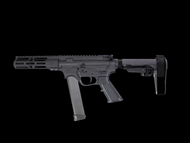
The Complete Guide to AR-9s: Everything You Need to Know
Apr 14th 2026
The AR-9 is one of the fastest-growing segments in the firearms market — and for good reason. Here's a deep dive into what it is, why shooters love it, and how to choose the right one.
If you've been paying attention to the shooting world over the last decade, you've seen the AR-9 go from niche curiosity to mainstream staple. An AR-9 is a pistol-caliber carbine (PCC) built on the AR-15 platform, chambered in 9mm. It combines the ergonomics and modularity of the AR-15 with the lower cost, reduced recoil, and versatility of the 9mm cartridge.
Whether you're considering one for home defense, competition shooting, range fun, or as a suppressor host, this guide covers everything you need to make an informed decision.
What exactly is an AR-9?
The AR-9 is a pistol-caliber carbine that shares the same lower and upper receiver layout as a standard AR-15, but it's engineered from the ground up to feed, fire, and eject 9mm pistol ammunition. The result is a firearm that feels immediately familiar to anyone with AR-15 experience, while offering distinct advantages that have made it enormously popular across several shooting disciplines.
Unlike a traditional AR-15, the AR-9 operates on a straight blowback or roller-delayed blowback system rather than a direct impingement or piston system, since 9mm doesn't generate the same pressures as intermediate rifle cartridges like 5.56 NATO.
AR-9 vs AR-15: what's the difference?
The AR-9 and AR-15 share DNA, but they're meaningfully different tools. Understanding those differences helps you decide which platform fits your use case.
AR-9 (9mm PCC)
Lower ammo cost per round. Less recoil and muzzle blast. Excellent suppressor host. Accepts pistol magazines. Shorter effective range (~100 yards). Straight blowback action.
AR-15 (5.56/.223)
Greater effective range (300–500+ yards). More terminal energy. Works with rifle magazines. Gas-operated action. Higher ammo cost. More muzzle blast and recoil than 9mm.
The short version: if you need a rifle for long-range work, defensive carbine distances, or hunting, the AR-15 wins. If you want something affordable to shoot, easy to suppress, and ideal for close-range use or competition, the AR-9 shines.
Why the AR-9 has exploded in popularity
The AR-9's rise isn't accidental. Several converging factors have made it one of the most in-demand platforms on the market:
Affordable ammunition
9mm is consistently one of the cheapest centerfire cartridges available. At typical range sessions, you can fire two to three times as many rounds for the same cost as 5.56 NATO, making the AR-9 the natural choice for high-volume shooters and competitors who go through hundreds of rounds per session.
Suppressor compatibility
The AR-9 is widely considered one of the best suppressor hosts available. The 9mm cartridge is subsonic in standard loadings, and with a suppressor, it becomes genuinely hearing-safe without the need for special subsonic ammunition. The reduced gas blowback compared to rifle calibers also means suppressors stay cleaner longer on 9mm builds.
Competition shooting (PCC division)
USPSA, IPSC, and Steel Challenge all have dedicated Pistol Caliber Carbine (PCC) divisions that have grown dramatically. The AR-9 dominates these divisions. Its low recoil, fast cycling, and familiarity to AR shooters make it devastatingly competitive. Many top PCC shooters report better split times and more consistent stage performance compared to their pistol or rifle counterparts.
Home defense versatility
A 9mm AR-9 configured as a pistol (without a stock) or SBR offers meaningful advantages for home defense. Over-penetration concerns are reduced compared to rifle rounds. The familiar AR controls make it accessible to shooters already trained on the platform. And magazine commonality with a carry pistol — if both run Glock magazines, for example — simplifies logistics considerably.
AR-9 magazine compatibility: Glock vs Colt pattern
One of the most important decisions when buying an AR-9 is which magazine pattern the lower accepts. The two dominant standards are:
Glock-pattern
Accepts factory Glock 9mm magazines. Most popular modern standard. Wide magazine availability. Compatible with extended and drum mags. Preferred by most new builds.
Colt-pattern (SMG)
Uses Colt SMG-style stick magazines. Older standard with dedicated following. Fewer aftermarket options. Still common in some competition circles and mil/LE builds.
If you already own Glock 9mm pistols, a Glock-pattern AR-9 is a logical choice — you can share magazines across your entire 9mm lineup. This single-stack logistics advantage is a major selling point for both competition shooters and home defenders.
Common uses for the AR-9
Dominant in USPSA, IPSC, and Steel Challenge PCC divisions. Low recoil enables fast splits and precise double-taps.
Reduced overpenetration vs. rifle rounds, AR ergonomics, and magazine commonality with carry guns.
Subsonic 9mm + suppressor = one of the quietest centerfire shooting experiences available.
Low ammo cost makes it ideal for high-volume range sessions. Fun, fast, and easy on the shoulder.
AR platform controls with minimal recoil make it a superb tool for building fundamental rifle skills affordably.
What to look for when buying an AR-9
-
Magazine compatibility — Decide on Glock or Colt pattern based on what magazines you already own or want to run.
-
Barrel length — 16" for a rifle-length legal build; 4–8" for SBR or pistol configurations (check NFA rules if applicable).
-
Action type — Straight blowback is most common and affordable; roller-delayed reduces felt recoil further but adds cost.
-
Suppressor thread pitch — Confirm 1/2×28 thread pattern if you plan to suppress. Most 9mm barrels use this standard.
-
Reliability and warranty — Buy from reputable manufacturers. Feed ramp geometry and extractor quality vary significantly across price tiers.
-
Build vs buy — AR-9 lowers are widely available; experienced AR builders can assemble a custom PCC for less than an equivalent factory rifle.
Top AR-9 manufacturers to know
The AR-9 market has matured significantly. Several manufacturers have established strong reputations for quality, reliability, and competition performance:
CMMG — Known for their Radial Delayed Blowback system, which dramatically reduces the felt recoil of 9mm blowback. Their Banshee and Guard series are popular competition and defense platforms. CZ Scorpion EVO (available in AR-compatible format via aftermarket lowers) brings Czech reliability to the PCC world. JP Enterprises dominates the high-end competition segment with their GMR series. Foxtrot Mike Products offers strong value at the budget end. PSA (Palmetto State Armory) provides affordable Glock-pattern AR-9 builds that punch well above their price point.
Legal considerations: pistol, SBR, or rifle?
The AR-9 exists in several legal configurations, and understanding the distinctions is important before you buy:
A standard AR-9 with a 16" barrel and rifle stock is straightforward — it's a rifle, no NFA paperwork required. Pistol-configured AR-9s (no stock, pistol brace, barrel under 16") occupy a different legal space that has been subject to regulatory changes. SBR configurations require a Form 4 and a $200 tax stamp in most jurisdictions. Always consult current ATF guidance and your state laws.
Maintaining your AR-9
The blowback action of an AR-9 runs dirtier than a gas-operated AR-15 — 9mm blowback pushes more carbon back into the action with every shot. This means your AR-9 benefits from more frequent cleaning than a comparable rifle-caliber AR.
Key maintenance priorities: clean the bolt face and extractor regularly (carbon buildup here causes the most common malfunctions), keep the feed ramp polished and clean, and ensure the buffer weight is correctly matched to your ammunition (heavier buffers reduce the violence of the blowback cycle on standard pressure loads).
Frequently asked questions
Is the AR-9 good for home defense?
Yes — the AR-9 is an excellent home defense option. It offers familiar AR ergonomics, reduced over-penetration compared to rifle calibers, and the ability to share magazines with a 9mm handgun. Its low recoil also makes it more manageable for a wider range of users under stress.
What's the effective range of an AR-9?
Practical effective range for 9mm from a carbine-length barrel is approximately 100–150 yards for accurate fire. Terminal performance of the 9mm cartridge degrades significantly beyond this range, making the AR-9 a close- to medium-range tool.
Can I suppress an AR-9?
Absolutely, and the AR-9 is one of the best platforms to suppress. Standard 147gr 9mm loads are subsonic, making them ideal for suppressed use without special ammunition. A quality 9mm suppressor on an AR-9 produces hearing-safe sound levels in most configurations.
Does the AR-9 work with standard AR-15 parts?
Most AR-15 furniture, handguards, triggers, grips, and stocks are compatible with AR-9 builds. The lower and upper receivers are typically proprietary to the 9mm platform, but the controls, buffer tube, and furniture mounting points remain standardized.